Three pages, three lists, zero amounts. What follows is every ingredient that appears on any of the three, which lists carry it, what the research used, and — for the ones that matter most — what it does to your medication.
The direct answer
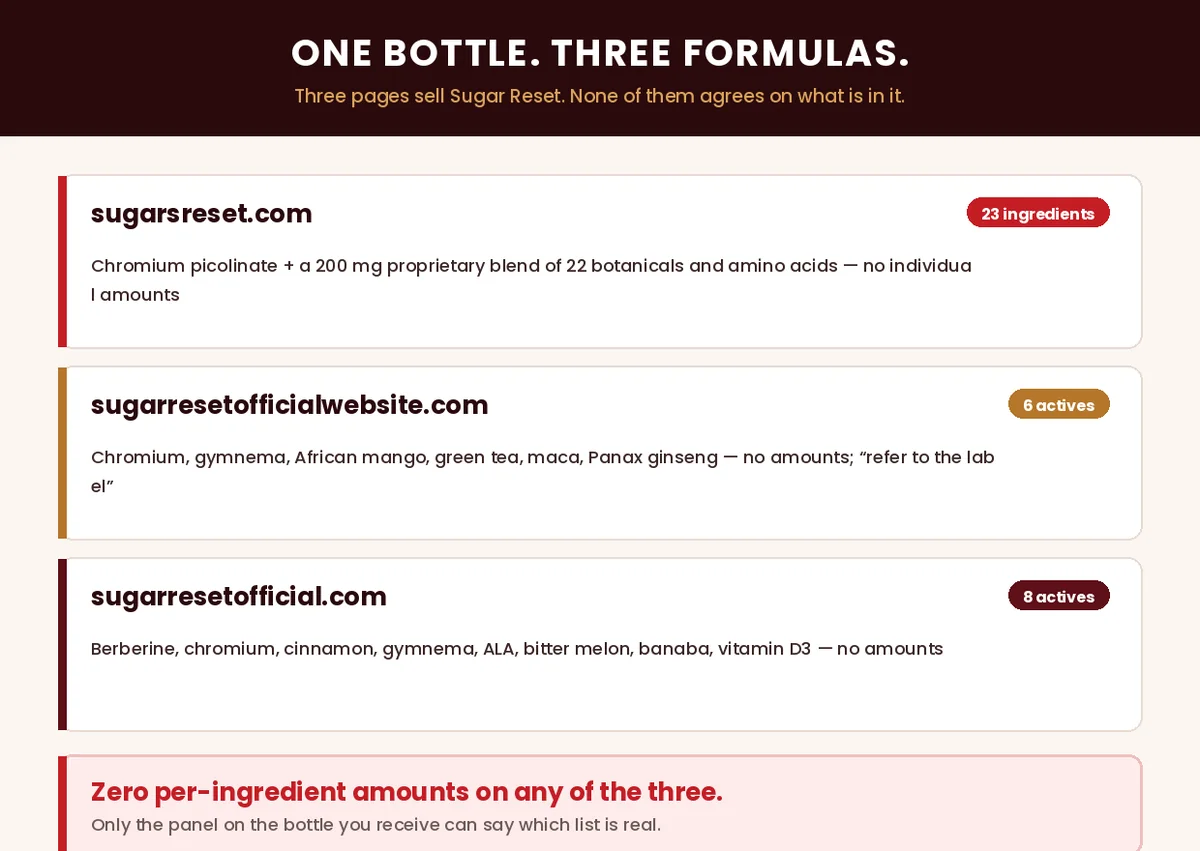
Three pages publish three different Sugar Reset formulas — 23 ingredients, six, and eight — and none prints a per-ingredient amount. All agree on chromium picolinate and gymnema. One version adds grapefruit extract, a licorice compound, guarana and nine amino acids; another adds berberine and cinnamon. The panel on the bottle you receive is the only authority.
Sugar Reset is a dietary supplement, not a diabetes treatment. Every published version contains chromium and gymnema, which lower blood sugar and stack with insulin, sulfonylureas and metformin. Never reduce a prescribed medication on your own; stopping one for a supplement risks ketoacidosis. One version lists grapefruit extract (raises blood levels of statins and blood-pressure drugs) and a licorice compound (raises blood pressure). Two contain undeclared caffeine. Take the bottle to a pharmacist before the first dose.
The three published formulas
| Ingredient | Printed amount | Used in research |
|---|---|---|
| Chromium picolinate | not stated (all three lists) | 200–1,000 mcg/day in glucose trials; 35 mcg DV |
| Gymnema sylvestre leaf | not stated (all three lists) | 200–400 mg/day standardised extract in trials |
| African mango seed (Irvingia gabonensis) | not stated (22-list and 6-list) | 150 mg twice daily in the published trials |
| Green tea leaf | not stated (22-list and 6-list) | 250–500 mg EGCG/day in trials; contains caffeine |
| Maca root and Panax ginseng | not stated (22-list and 6-list) | 1.5–3 g/day maca; 200–400 mg/day ginseng extract |
| Grapefruit fruit extract | not stated (22-list only) | any amount matters for CYP3A4 drug interactions |
| Monoammonium glycyrrhizinate (licorice) | not stated (22-list only) | glycyrrhizin raises blood pressure and lowers potassium with continued use |
| Berberine HCl and Ceylon cinnamon | not stated (8-list only) | 1,000–1,500 mg/day berberine; 1–6 g/day cinnamon in trials |
| Amino acids (L-glutamine, L-tyrosine, L-arginine, GABA and others) | not stated (22-list only) | studied at 3–10 g/day each |
Comparing Sugar Reset bundles
The Sugar Reset discount is applied by bundle size: $79 a bottle for two, $69 for three, $49 for six, with free US shipping on the larger packs.
Check Sugar Reset Bundle PricesOfficial website checkout · 60-day guarantee · confirm the terms before paying
Every ingredient, examined
1. Chromium picolinate Partly
Amount printed: not stated · appears on: all three lists · studied at: 200–1,000 mcg/day in glucose trials; 35 mcg DV
How much chromium is in Sugar Reset?
Nobody says. It is the one ingredient every version of the formula agrees on, and not one of the three selling pages prints an amount — not even against the 35 mcg Daily Value.
Chromium picolinate is the most-studied mineral for insulin sensitivity, and the trials that show any effect use 200 to 1,000 mcg a day, mostly in people with diagnosed type 2 diabetes. The Daily Value is 35 mcg. On the sugarsreset.com version chromium is listed separately from the blend, which usually means its amount could have been printed; it was not. Without a figure it cannot be placed on the research scale at all.
Worth knowing: Chromium plus a glucose-lowering drug can push blood sugar too low. Anyone on insulin or a sulfonylurea should ask first. · NIH ODS — Chromium
2. Gymnema sylvestre leaf Partly
Amount printed: not stated · appears on: all three lists · studied at: 200–400 mg/day standardised extract in trials
Does gymnema lower blood sugar?
In trials at 200–400 mg of standardised extract, modestly, mostly in people with diabetes — which is exactly why it needs a dose printed beside it and a caution beside that.
Gymnemic acids blunt the perception of sweetness on the tongue and are studied for glucose-lowering effects. Both the benefit and the risk depend on the amount, and the amount is not published on any page. Inside a 200 mg blend shared with 21 other ingredients, the sugarsreset.com version cannot supply a trial dose; the six- and eight-ingredient versions state no amount at all.
Worth knowing: Additive with insulin, sulfonylureas and metformin. Symptoms of low blood sugar — shakiness, sweating, confusion — are a reason to stop and call a clinician. · NCCIH — Gymnema
3. African mango seed (Irvingia gabonensis) Partly
Amount printed: not stated · appears on: 22-list and 6-list · studied at: 150 mg twice daily in the published trials
What does African mango do here?
It is studied for weight and metabolic markers at 150 mg twice a day of a specific extract. No amount is printed on either page that lists it.
The published trials are small, industry-funded and use a branded extract at 300 mg a day. Whether Sugar Reset contains anything like that is unknowable: on one page it is one of 22 ingredients sharing 200 mg; on another it is one of six with no amount.
Worth knowing: Generally well tolerated in trials. Headache and sleep disturbance reported. · NIH ODS — weight-loss ingredients
4. Green tea leaf Flagged
Amount printed: not stated · appears on: 22-list and 6-list · studied at: 250–500 mg EGCG/day in trials; contains caffeine
Is Sugar Reset stimulant-free?
Not on two of the three lists. Green tea leaf contains caffeine, and the 22-ingredient version adds guarana. A product that says “take before breakfast” and contains caffeine should say so; none does.
Green tea catechins are studied for glucose and weight at hundreds of milligrams of EGCG, far more than a 200 mg blend of 22 can hold. Its caffeine content is the practical point: it explains the “steadier afternoon energy” testimonials and is a reason for evening dosing to be avoided. Rare cases of liver injury are associated with concentrated green tea extracts.
Worth knowing: Contains caffeine. Concentrated extracts carry a rare liver caution; stop and seek advice for dark urine or yellowing skin. · NCCIH — Green tea
5. Maca root and Panax ginseng Partly
Amount printed: not stated · appears on: 22-list and 6-list · studied at: 1.5–3 g/day maca; 200–400 mg/day ginseng extract
Why are maca and ginseng in a glucose product?
They are the “energy” half of the formula. Ginseng has modest glucose data; maca has none. Neither has a printed amount, and maca's studied doses are grams — impossible inside a 200 mg blend.
Panax ginseng shows small effects on fasting glucose in some trials at 200–400 mg of extract. Maca is studied for energy and libido at 1.5–3 g a day. On the 22-ingredient page both share 200 mg with 20 others; on the six-ingredient page no amount exists.
Worth knowing: Ginseng can interact with warfarin and, additively, with glucose-lowering drugs. · NCCIH — Asian ginseng
6. Grapefruit fruit extract Flagged
Amount printed: not stated · appears on: 22-list only · studied at: any amount matters for CYP3A4 drug interactions
Why does grapefruit extract matter?
Because grapefruit inhibits the CYP3A4 enzyme that clears many drugs — statins, calcium-channel blockers, some immunosuppressants and sedatives — and raises their blood levels. The people buying a glucose supplement are disproportionately on those drugs.
This is the single most important line in the 22-ingredient version, and it is buried at the end of a proprietary blend. Whether the amount is enough to matter is unknown because no amount is printed. The other two selling pages do not list grapefruit at all — which means either the formula differs or one list is incomplete.
Worth knowing: Ask a pharmacist before the first dose if you take a statin, a blood-pressure medication, or any drug with a grapefruit warning on its leaflet. · FDA — grapefruit and drugs
7. Monoammonium glycyrrhizinate (licorice) Flagged
Amount printed: not stated · appears on: 22-list only · studied at: glycyrrhizin raises blood pressure and lowers potassium with continued use
Is there licorice in Sugar Reset?
On the 22-ingredient version, yes — as monoammonium glycyrrhizinate, a licorice compound. With continued use glycyrrhizin can raise blood pressure and lower potassium. The amount is not printed.
This matters more than it sounds: high blood pressure and diabetes travel together, and a daily product taken for months is exactly the exposure pattern glycyrrhizin cautions describe. Neither of the other two pages lists it.
Worth knowing: Anyone with hypertension, heart or kidney disease, or on diuretics should ask first. · NCCIH — Licorice root
8. Berberine HCl and Ceylon cinnamon Partly
Amount printed: not stated · appears on: 8-list only · studied at: 1,000–1,500 mg/day berberine; 1–6 g/day cinnamon in trials
Does Sugar Reset contain berberine?
Only according to one of the three selling pages. Berberine is the one botanical with glucose data comparable to a drug — at 1,000–1,500 mg a day — and it interacts with many medications. No amount is printed.
Berberine at trial doses is genuinely effective and genuinely interacting: it inhibits CYP enzymes and is unsafe in pregnancy and infancy. Cinnamon's glucose data are mixed and use gram-level doses. If the eight-ingredient list is correct, these are the two ingredients that most need a printed amount. If it is not correct, a page is advertising ingredients the bottle does not contain.
Worth knowing: Berberine: avoid in pregnancy and breastfeeding; interacts with metformin, cyclosporine and many others. · NCCIH — Berberine
9. Amino acids (L-glutamine, L-tyrosine, L-arginine, GABA and others) Flagged
Amount printed: not stated · appears on: 22-list only · studied at: studied at 3–10 g/day each
What are the amino acids doing in a 200 mg blend?
Padding the count. Nine amino acids are listed on the 22-ingredient version, each studied at grams a day, all sharing 200 mg with thirteen botanicals. Spread evenly that is about 9 mg each — roughly a thousandth of a studied dose.
L-tryptophan in particular is worth noting for anyone on an antidepressant, and L-arginine for anyone on blood-pressure medication — though at these amounts the concern is theoretical. The practical point is that a blend this crowded cannot dose anything, and the amino acids make that arithmetic obvious.
Worth knowing: L-tryptophan with SSRIs or MAOIs warrants a pharmacist check, regardless of dose. · NIH ODS — fact sheets
What no page publishes
- No per-ingredient amount, on any of the three published lists
- No stated serving volume — “1–2 droppers” with no millilitres
- No Supplement Facts panel image on any selling page
- No caffeine declaration, despite green tea and guarana on two lists
- No grapefruit or licorice interaction warning on the page that lists them
- No manufacturer or distributor named
The arithmetic on the 22-ingredient version
If that list is correct, thirteen botanicals and nine amino acids share a 200 mg blend. Spread evenly that is about 9 mg each. Gymnema is studied at 200–400 mg; green tea at 250–500 mg of EGCG; maca at 1.5–3 g; each amino acid at 3–10 g. No split of 200 mg reaches a studied dose for any of them. This desk never estimates a blend split — the point is that no split works.
The other missing disclosures
- No serving volume. “One to two droppers” with no millilitres, on a 60 mL bottle sold as 30 days.
- No caffeine declaration, despite green tea on two lists and guarana on one.
- No manufacturer, lot or third-party test named anywhere.
Read how the mechanism holds up, or see the claim-by-claim rulings.
Questions people ask about this
What are the ingredients in Sugar Reset?
It depends on the page: chromium plus a 22-item blend; six actives; or eight including berberine. All agree on chromium and gymnema. None prints an amount.
How much chromium is in Sugar Reset?
No page says. Trials use 200–1,000 mcg; the Daily Value is 35 mcg.
Does Sugar Reset contain grapefruit?
The 22-ingredient version lists grapefruit fruit extract, which raises blood levels of statins and blood-pressure drugs. The other two lists do not.
Does Sugar Reset contain berberine?
Only according to one of the three selling pages. If your panel lists it, treat the product as you would a drug and avoid it in pregnancy.
Sugar Reset Official Website
per bottle on the 6-bottle pack · free US shipping on 3 and 6
Check Current Price 60-day guarantee · official checkout only